Why I’m passionate about discovering math and helping students to do so.
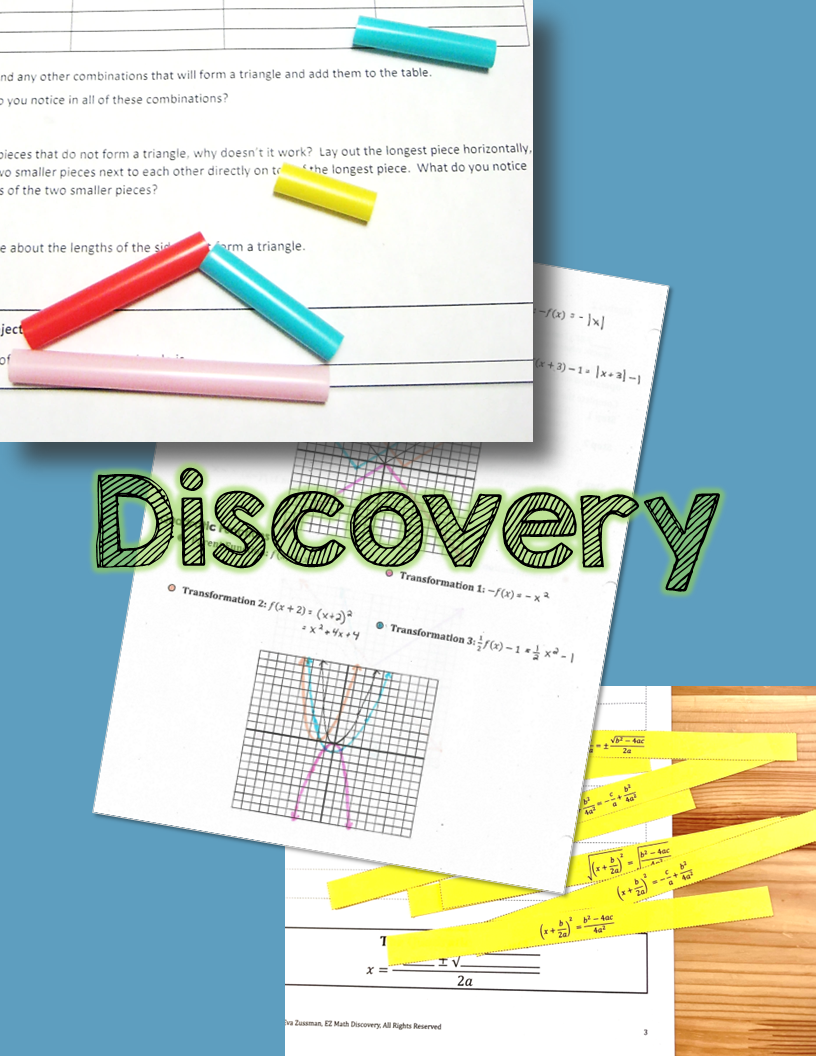
Discovery Learning
My first semester in grad school to receive my teaching license, the school where I was observing used the textbook Discovering Geometry. It was so different from the way I learned geometry and I was amazed. The students in the urban school that I was observing were not the strongest mathematically, but engaging them in the process of discovery and inquiry helped them to be more invested in what they were learning.
Students learn better when they make connections to previous knowledge and are actively engaged. I wanted to include more student engagement and inquiry activities into my classroom to help my students.
I noticed this other times as well. While my mathematics education was almost the opposite of discovery-based, there were times when the reasoning behind a concept was so obvious it had to be taught. I remember learning the distance formula based on the idea of Pythagorean Theorem. It made so much sense. It was obvious to me and, as someone who has a hard time with rote memorization, it was one less thing to remember. I was surprised when I later learned that some students weren’t taught that connection and just had another formula that they needed to memorize. It seemed a no-brainer to me to explain the connection to make it easier to learn. I wanted to incorporate that for my students as much as possible.
Another area where we can make connections is in factoring polynomials. While some properties of polynomials are easier to discover, like properties of exponents, it is not so natural to discover how to factor. As an algebra student, I remember understanding why we factor out the GCF and how that can be helpful. I also remember discovering patterns when factoring quadratic trinomials where the leading coefficient is one, similar to the investigation that I share here. But when it came to quadratics where the leading coefficient was not one, the only method I remember learning was guess and check. Maybe we did learn another method, but it just didn’t stick with me. Maybe I was absent that day, like the day we learned slope (sorry Mrs. Graves).
Eventually, during one of my first years of teaching, the textbook I was using demonstrated this by using factoring by grouping. It made so much sense! It was basically working backwards of what you would do if you were multiplying. Isn’t that what factoring is? I explained to my students that I was going to teach them a sure-fire method for factoring these types of quadratics, even though I was only ever taught to guess and check. How lucky they were to have a method (I don’t know if they agreed but they definitely spent less time trying to factor than I did)! Since then I have become aware of a few other methods, such as the box method. Tyra from Algebra and Beyond recently sent an email to her followers about different methods for factoring. I was so excited by this because the more tools and options we can give our students the better.
As humans, we are all unique, and therefore think differently. What might be obvious to one person, is not to another and vice versa. Therefore, the more tools students have at their disposal, the more likely they are to be successful.
Allowing students to discover their math, better equips them to problem solve.
I often find with freshmen, they expect me to tell them exactly, step-by-step, how to solve a problem. While I do that from time to time, I prefer to explain to them why we are doing what we are doing before telling them what to do. Students will often balk at this at first, but I have found over time that this process of inquiry and engagement helps students to get more excited about math (even if it’s still not their favorite subject).
As an educator, I strive to make math fun and engaging for students and I hope to share this with others. So join me.