Explaining math conceptually helps students in the long run.
Many people see math as just a bunch of facts you need to memorize, like people and dates in history. While definitely not my area of expertise, I know that most history education today has shifted away from the rote memorization of names, places, and dates. While there is a place for that, education today focuses on the themes of different eras, which is where the lessons are learnt.
The same is true in mathematics. If you understand the concepts and naturally occurring mathematical principles in our world that is where the most understanding and application takes place. As Freshman, many students just want to be told step-by-step how to solve a problem. They’re uncomfortable at first with explaining why the concept makes sense or how it builds from their prior knowledge. They just want to be told what to do and move on. In the long run however, seeing every problem case as unique means that every time they go to solve a problem they have to figure out which of a hundred different possibilities this case fits into vs having a dozen or so general categories and then breaking down the specifics of that case. In the long run it’s a lot less to memorize.

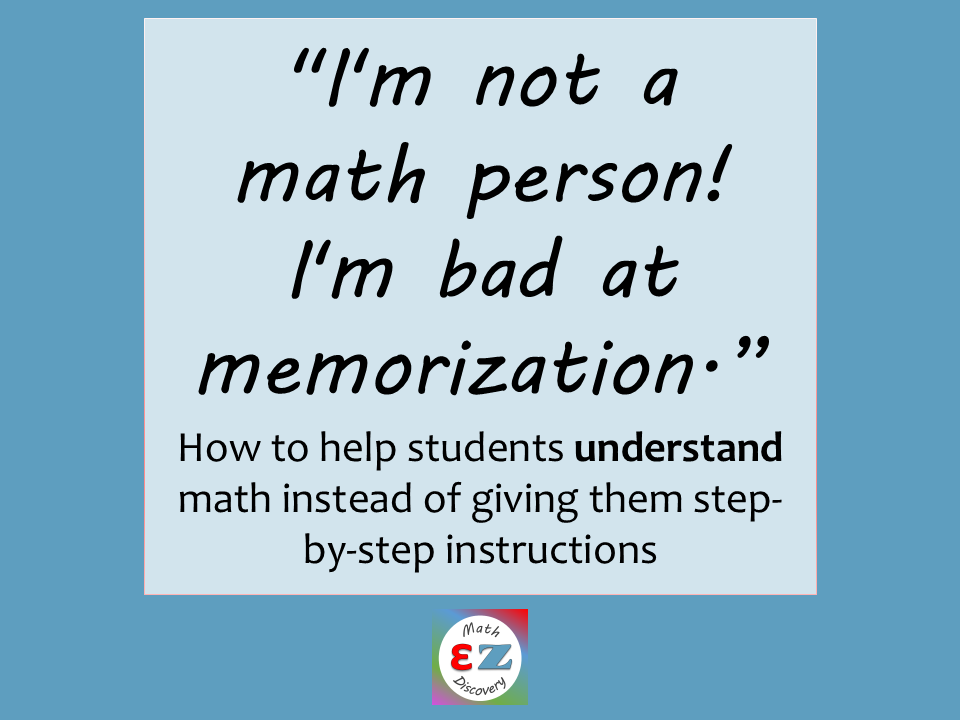
This usually helps get my students on board. I honestly share with them that I am not good at memorizing a lot of details. For example, I have a hard time remembering numbers such as how much things cost or what year something happened. Most people are shocked by this, saying “but you’re a math person.” Even more shocking is that I had a really hard time memorizing my math facts in elementary school. Only when I got older and started to use them more and understand them more conceptually did they come easier to me. That is really reassuring for students!
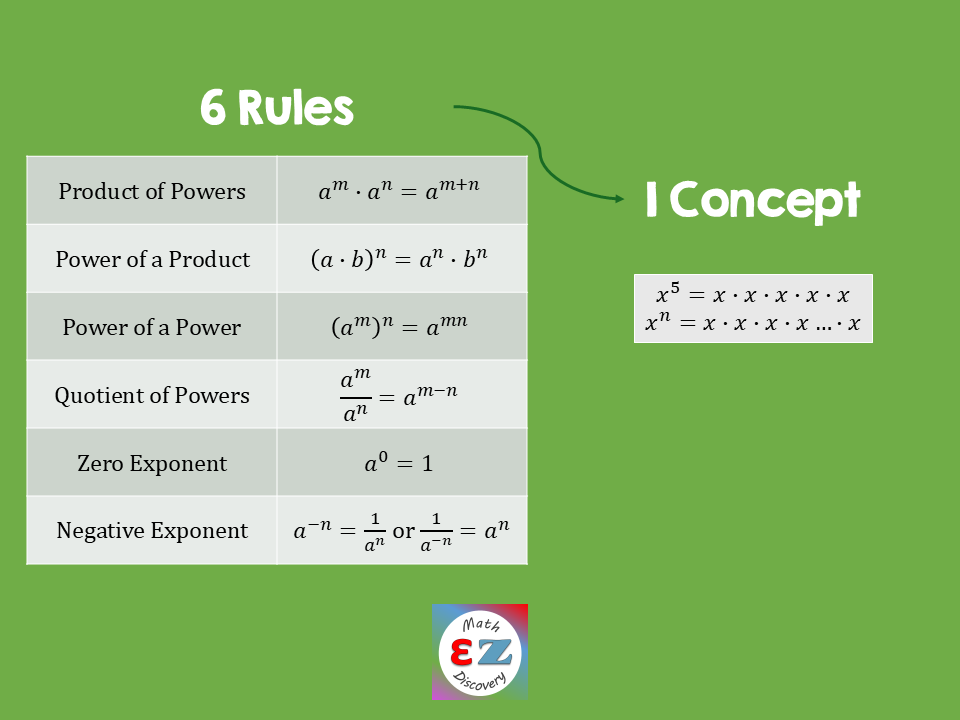
Now this makes things easier in the long run. Instead of just memorizing the properties of exponents, finding arc length of a circle, or finding the distance between two points in the coordinate plane, if you’re stuck you can figure it out. Just break it down into something you do know, like the definition of an exponent, finding the diameter of a circle, or Pythagorean Theorem. To further illustrate, if you know that one concept (the definition of an exponent), that can translate to being able to derive six more rules, even more when you consider how it applies to rational exponents or logarithms later down the line. That’s a lot less memorizing.